

Have you ever searched “what is an expatriate” and weren’t quite sure what the term really means?
The term comes up often in HR and business conversations, especially as companies grow across countries and manage international teams.
At first, it sounds fun. But in the workplace, the meaning can involve contracts, tax rules, relocation support, and global mobility policies.
This blog explains what an expatriate is and why the term matters in today’s global workforce.
What Is an Expatriate?
An expatriate, often called an “expat,” is a person who lives and works in a country other than their home country.
For example, an American engineer working in Germany or a Canadian nurse working in the United States would both be considered expatriates.
This move is usually temporary, lasting a few months to a few years. However, some expats end up staying in their new country for much longer and occasionally, permanently.
The word “expat” is simply a shorter, more casual version of “expatriate.” You’ll often hear people use expat in everyday conversations, while expatriate tends to show up in formal HR documents, employment contracts, and company policies.
What Are the Different Types of Expatriates?
Not all expatriates are the same. They move abroad for different reasons and under different circumstances.
In HR, understanding what an expatriate is and the different types helps companies create the right policies, benefits, and support systems for each situation.
1. Corporate Expatriates (Employer-Sponsored)
Corporate expatriates are the most common type you’ll come across in HR. These are employees sent abroad by their company to work in another country. Here’s what makes them stand out:
- The company handles the full relocation process, including housing and moving costs.
- Employees receive a special benefits package designed for international assignments.
- The employer provides tax support to help the expat manage finances in a new country.
- Assignment length is usually set by the company, ranging from one to several years.
2. Self-Initiated Expatriates
Self-initiated expatriates are individuals who choose to move abroad on their own without being sent by a company. They find jobs in a new country through their own effort and planning. Here’s what’s important to know:
- These expats move independently, without any employer pushing or sponsoring the move.
- HR involvement is usually limited compared with that of corporate expats.
- However, companies still need to handle compliance, taxes, and local employment laws.
- This type is becoming more common as remote and global job opportunities grow.
Difference Between Expatriate Vs ImmigrantVs Migrant
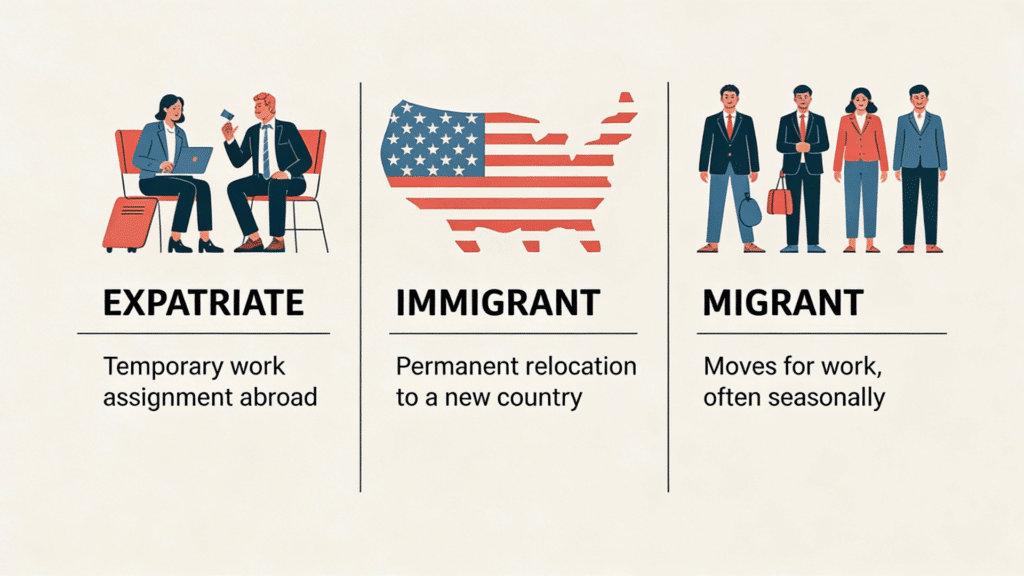
These three terms are often mixed up, but they actually mean different things in HR and employment. Here’s a simple breakdown:
| Factor | Expatriate | Immigrant | Migrant |
| Move Type | Temporary work assignment abroad | Permanent relocation to a new country | Moves for work, often seasonally |
| Intent | Plans to return home eventually | Intends to settle permanently | Follows work opportunities |
| Employer Role | Often company-sponsored | Moves independently | Usually independently driven |
| HR/Legal Focus | Tax, benefits, and compliance support | Citizenship and residency process | Work permits and labor laws |
These terms often get mixed up because they all involve people living outside their home country. However, for HR teams, getting employee classification right is very important, as it directly impacts company policies, compliance with local laws, and benefits eligibility.
Why Do Companies Send Employees Abroad?
There are many sound business reasons for companies to send employees abroad. Here are the most common ones:
- Leadership Development: Companies send high-potential employees abroad to build their leadership skills and global thinking.
- Opening a New Office: When expanding into a new market, businesses rely on trusted employees to set things up on the ground.
- Knowledge Transfer: Experienced employees are sent to share skills, processes, and company culture with local teams.
- Client Servicing: Some clients require on-the-ground support, necessitating placing employees closer to them.
- Project Delivery: Certain projects require direct oversight, so companies send specialists to ensure they run smoothly and on time.
Expatriate Challenges for Employees and HR Teams

Sending employees abroad comes with its own set of challenges, both for the employee settling into a new country and for the HR teams managing everything behind the scenes.
Common Expat Challenges for Employees
Moving to a new country is exciting, but it comes with real challenges that employees often face:
- Adjusting to a completely different culture, lifestyle, and workplace can take time and feel overwhelming at first.
- Feeling isolated and far from family and friends can affect mental well-being and overall job performance.
- Spouses and children also go through a tough adjustment period, which adds pressure on the employee.
- Language differences can make everyday communication and professional interactions difficult to manage.
Common Challenges for Employers and HR
Managing expatriate employees isn’t simple for HR teams either. Here are the key challenges companies often face:
- Handling payroll across different countries involves complex tax rules, currencies, and local regulations.
- Staying on top of immigration compliance requires constant monitoring of visas, work permits, and legal deadlines.
- Permanent establishment risk can arise when an expat’s presence in a country triggers unexpected tax obligations for the company.
- Retaining employees after their assignments end is a common challenge, as many expats explore new opportunities upon returning home.
U.S. Visa Categories for Expatriates (A Practical Overview)
One of the most important parts of expatriate managementis making sure the right visa is in place before an employee starts working in the U.S. Here are the most common U.S. visa categories HR teams work with:
- L-1 Visa: Used for intra-company transfers, this visa allows multinational companies to move employees from an overseas office to a U.S.-based office.
- H-1B Visa: Designed for specialty occupations that require at least a bachelor’s degree or equivalent. This is one of the most commonly used work visas in the U.S.
- E-2 Visa: An investor visa that allows nationals of certain treaty countries to work in the U.S. after making a qualifying investment in a U.S. business.
- O-1 Visa: For individuals with extraordinary ability or achievement in their field, such as science, arts, education, or business.
- TN Visa: Available to Canadian and Mexican professionals under the USMCA (formerly NAFTA) agreement, covering specific professional categories.
How Expatriates are Taxed and Paid Abroad?
When employees work across borders, tax, payroll, and legal responsibilities become much more complex. Here’s what HR teams need to know.
Taxation Rules for Expats
- Expats can be required to pay taxes in both their home country and the country where they work, a practice known as double taxation.
- Many countries have tax treaties in place to prevent employees from being taxed twice on the same income.
Payroll Structures Used for Expats
Depending on the situation, companies typically follow one of three payroll approaches:
- Home Payroll: The employee continues to be paid through their home country’s payroll system while working abroad.
- Host Payroll: The employee is moved onto the payroll system of the country where they are currently working.
- Split Payroll: The employee’s salary is divided between their home and host countries.
HR teams play a key role in sponsoring and managing visas and work permits for expat employees. Working remotely from another country without proper work status can create serious legal and tax risks for both the employee and the company.
U.S. Tax Rules for Expatriates (What HR and Expats Must Know)
If you are a U.S. citizen or green card holder working abroad, U.S. tax rules still apply to you. Understanding what an expatriate isfrom a U.S. tax perspective is important for both employees and HR teams.
- Worldwide Taxation: The U.S. taxes its citizens and green card holders on all income earned globally, even when they live and work in another country.
- Foreign Earned Income Exclusion (FEIE): This IRS provision allows expats to exclude a portion of their foreign-earned income from U.S. tax liability, thereby reducing the overall tax burden.
- Foreign Tax Credit (FTC): If an expat pays taxes in their host country, the FTC helps avoid paying tax twice on the same income.
- Totalization Agreements: The U.S. has agreements with several countries to prevent expats from paying Social Security contributions in both countries at the same time.
- IRS Filing Requirement: Regardless of where they live, U.S. expats must file a federal tax return every year. Failing to meet this requirement can lead to serious penalties.
What is Expatriate Repatriation?
Repatriation is the process by which an expatriate returns to their home country after completing an international assignment.
While it may sound simple, returning home can be a significant adjustment for many employees.
After spending months or years in a different country, expats often find that things at home, including their roles, workplace culture, and even their personal lives, have changed.
For HR teams, managing repatriation well is just as important as planning the original assignment, as it directly affects employee satisfaction and retention.
Final Summary
An expatriate is a person who lives and works outside their home country, whether through a company assignment or by choice. Understanding what Is an expatriate the first step toward effectively managing global employees.
For HR teams, managing expatriates goes far beyond just relocation.
Getting these details right helps companies protect themselves legally, better support their employees, and build stronger global teams over time.